Cooper Graham
How to Flirt with A Naked WerewolfCooper Graham is the werewolf alpha at the center of the novel’s collision between Grundy’s human community and the hidden world of the pack. His significance lies in the contradiction he must learn to inhabit: he is both an intensely protective lover and a man who once killed twelve invading wolves, people whose deaths left him traumatized and convinced that he was unfit for his family. Through Mo Duvall-Wenstein, Cooper’s secrecy becomes intimacy, his violence becomes an ethical burden that must be acknowledged rather than romanticized, and his authority is gradually redirected toward care, accountability, and the future of a mixed human-werewolf family.
Identity and First Encounters
Cooper first enters Mo’s experience as a physically imposing presence. When she trips on an uneven floorboard at the saloon, she pitches into the man standing behind her; the contact leaves her cheek tingling against his chest while the heat of his hands seems to burn through her shirt. His later complaint that she needs to do something about her depth perception establishes the teasing friction between them, but the encounter also gives their attraction a distinctly bodily register: warmth, size, proximity, and involuntary reaction arrive before explanation.
That attraction develops through resistance rather than easy trust. When Mo pushes Cooper with all her strength, he catches her hands effortlessly and holds them against his chest. His warmth comforts her even as she resents needing comfort from him, and the conflict culminates in their first kiss. Cooper’s physical power is therefore double-edged from the beginning. It can make him seem immovable and threatening, yet it is also the source of the bodily reassurance Mo cannot dismiss. The same blue-green eyes later seen in the dark alley, focused on John Teague, connect the flirtatious man at the saloon with the frightening, interventionist figure who protects her from danger.
The Werewolf Revelation
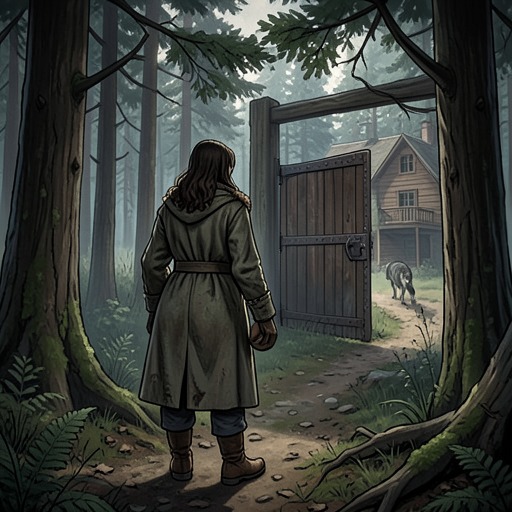
Cooper’s identity is exposed through injury and transformation rather than confession. A nighttime visitor arrives at Mo’s door apparently hurt, collapses outside, and is discovered in the form of a wolf. A warm golden glow ripples along the animal’s body, and the wolf disappears, leaving Cooper seated with a quilt around his waist and an expression of mortification. The revelation makes his embarrassment as important as the supernatural spectacle: he is not presented as an unknowable monster, but as a man whose hidden body and social rules have suddenly become impossible to conceal.
The discovery nevertheless places Mo inside a dangerous uncertainty. After a wolf attack leaves Susie Quinn mauled, she confronts Cooper about the timing of his arrival as a wolf and the attack. Cooper admits that he does not remember being there, cannot smell his scent in the place, and can smell only blood—Susie’s blood. His lack of memory prevents a simple exoneration. The possibility that wolf-state memory may be incomplete turns his transformation into an ethical and narrative problem: Cooper may be protective, but even he cannot immediately account for everything his other form has done. When a bear threatens Mo, however, wolf-Cooper positions himself between her and the animal, standing wide and defensive with the hair on his back bristling. Protection is instinctive and unmistakable even while responsibility remains uncertain.
Cooper’s explanation places his body within a larger kinship system. He tells Mo that the pack includes people across the world and that intermarriage has produced increasing numbers of dead lines, families whose members can no longer transform. He treats the weakening of the bloodline ambivalently: his grandfather considers outside marriage beneficial because it prevents the pack from becoming inbred, even though it also reduces the transmission of wolf magic. The supernatural is thus governed not only by individual choice but by heredity, marriage, and the pack’s long-term survival.
Alpha Authority and Moral Injury
Cooper’s authority is more than a title. As alpha, he serves as a leader for the village, makes decisions for the pack and its families, and directs responses to threats ranging from wild animals to criminals and other unwanted intruders. He explains that leadership required him to send people he cared about into fights, while also taking too much responsibility onto himself. His statement that he hurt many people reveals an alpha identity shaped not by uncomplicated dominance but by the belief that command makes him answerable for every consequence.
The source of his deepest guilt is an assault by a rival pack from outside Vancouver. About a year after Cooper became alpha, the rival wolves dragged Maggie Graham from the family home and threatened to snap her neck unless he surrendered control of the valley. Their alpha, Jonas, had exhausted his own packlands and selected Cooper’s territory after carefully studying its vulnerabilities, village layout, and available fighters. The attack therefore combines personal coercion with territorial conquest: Maggie is used as leverage, while Cooper’s perceived weakness as alpha becomes the opening through which an entire community is endangered.
Maggie brings down one attacker, but Cooper kills the remaining eleven, one by one. When he returns to human form, all twelve wolves from the invading pack are dead. The event saves the valley in immediate practical terms, yet Cooper experiences it as a moral catastrophe rather than a victorious defense. He insists that the victims were people despite their fangs and fur, just as members of his own pack were people. His family and packmates interpret the massacre as proof that he was a great leader, and his father would have been proud; Cooper interprets the same action as evidence that something terrible inside him was capable of killing men and women alike.
The aftermath resembles moral injury more than ordinary regret. Cooper wakes screaming from nightmares, cannot bear to remain around his family, and loses trust in himself. His withdrawal is not simply fear that others will reject him; it is fear that he might endanger the people he loves. Mo’s response begins a different reconstruction of the event. When Cooper asks whether she is angry with him, her acceptance does not erase the dead or declare the violence harmless. Later, she tells him to have no regrets and not to torture himself with guilt, offering a relational alternative to the self-condemnation that has isolated him. Her stance allows him to remain responsible without being permanently reduced to his worst act.
Love, Marking, and Domestic Life
Cooper’s relationship with Mo develops from physical attraction into a werewolf mate bond with consequences beyond romance. He later explains that biting and marking her means he can never mate with anyone else. The act is therefore both erotic and socially binding: it makes Mo his mate, establishes exclusivity, and commits his future to a relationship whose implications he had not fully explained at the start. When he identifies her before others as his mate, he also insists that she has a stake in pack decisions, converting private attachment into public standing.
Their domestic life makes that transformation visible through ordinary objects. Cooper’s T-shirts begin appearing in Mo’s closet, his toothbrush sits beside hers, and he brings bags of groceries to replace the mountains of food he consumes. He effectively moves into her house without a formal negotiation. For Mo, the blurring of boundaries is unusual enough that it would normally provoke panic, but his presence becomes something she wants and can scarcely imagine losing. Their intimacy is expressed through shared space, appetite, scent, and physical play, making the household a bridge between human domesticity and werewolf bonding practices.
Separation exposes the intensity of that bond. Cooper leaves on an elk-hunting expedition at Becker Ridge expected to last three or four days and promises to return as soon as the weather permits. In his note, he asks Mo not to wash his scent from her body, reserving her hair and face as acceptable exceptions. The request makes scent a form of continuing presence: while absent, he remains materially and symbolically attached to her through the mark of his body. His later apology acknowledges that leaving her was not an emotionally neutral decision. He says that he believed he could handle the situation, while knowing that marking her had made any other mate impossible.
Family, Pregnancy, and Future
Cooper’s responsibilities expand when Mo discovers that she is pregnant. She searches the werewolf books for information about human women carrying werewolf babies and finds little guidance beyond shortened gestation and overwhelming food cravings. Wolves carry their young for three months, while human women carrying werewolf babies apparently split the difference at roughly six months. The pregnancy makes Cooper’s private biology a public family future: bloodline continuity, human-werewolf intermarriage, and the scarcity of reliable knowledge all become immediate rather than theoretical.
The child also changes the meaning of Cooper’s earlier secrecy. The relationship is no longer only a negotiation between a human newcomer and a hidden pack member; it now concerns the continuation of wolf magic and the social place of a child produced across the boundary between communities. Cooper’s mate-marking, his pack authority, and his fear of family all converge in this new responsibility. The domestic objects that once signaled a lover’s gradual occupation of Mo’s home now point toward a household intended to contain a larger family.
That future culminates in Cooper’s proposal. With his warm hand over Mo’s hand and the belly that will be full and round within weeks, he asks her to marry him and raise their baby with him. The proposal is deliberately embodied: hand, scent, pregnancy, and shared parenthood replace abstract promises. Cooper’s ending is consequently not a return to uncomplicated innocence. He remains a transformed man with a violent past, a supernatural inheritance, and obligations to a pack, but he chooses to bind those burdens to Mo through marriage and cooperative care rather than escape them through isolation.
Narrative Role and Significance
Cooper functions as the novel’s principal shapeshifter figure in both literal and ethical senses. His body changes between human and wolf, while the reader’s understanding of him changes from attractive stranger, to possible threat, to protector, to alpha burdened by a massacre, and finally to partner and prospective father. The book repeatedly holds these versions together instead of allowing one to cancel the others. His tenderness does not erase his capacity for violence, and his violence does not make his tenderness false.
His story also tests the meaning of protection. Cooper can place himself between Mo and a bear, defend the valley, provide food, mark a mate, and lead a community, yet each protective role carries a danger of control or self-sacrifice. The rival-pack massacre shows the destructive extreme of leadership when protection is measured only by victory. His later movement toward confession, apology, and shared decision-making offers a less isolating model: strength becomes valuable not because it proves him invulnerable, but because it can be brought into accountable relationship.
By the end, Mo’s refusal to let him keep torturing himself and Cooper’s request for marriage establish the central reconciliation in his character arc. He does not receive absolution through forgetting what happened; he receives a possible life after it. The proposed marriage joins love, kinship, bloodline, and community, giving Cooper a future in which the alpha, lover, survivor, and father can occupy the same body without the past being denied.